


Investigate the Source: What kind of source is Vaccine Choice Canada?
SKILL: Investigate the Source
DIFFICULTY: Simple
SUBJECT(S): Science
Posted: November 20, 2025
Students will investigate Vaccine Choice Canada to learn it is an anti-vaccination advocacy group known for spreading disinformation.
Link to Example
Vaccine Choice Canada (Instagram)
Background
In early November 2025, Canada lost its measles elimination status, which it had maintained for nearly three decades, following a year-long outbreak caused in part by declining vaccination rates.
Measles is a highly contagious, vaccine-preventable disease. Once common in childhood, its typical symptoms include a body rash, fever, cough, runny nose, and inflamed eyes. While most people recover without long-term issues, measles can be serious or even fatal, especially for children under 5 and for people with weakened immune systems.
Measles vaccines are safe and effective, and typically given to children in two doses before they reach school age.
About the Example
Teacher note: If you cannot access Instagram, click here for a screenshot of the post that you can share with your students.
According to this Instagram post from a group called Vaccine Choice Canada, the “natural” measles infection isn’t what we should be worried about, but rather the deadly vaccine used to prevent it, instead!
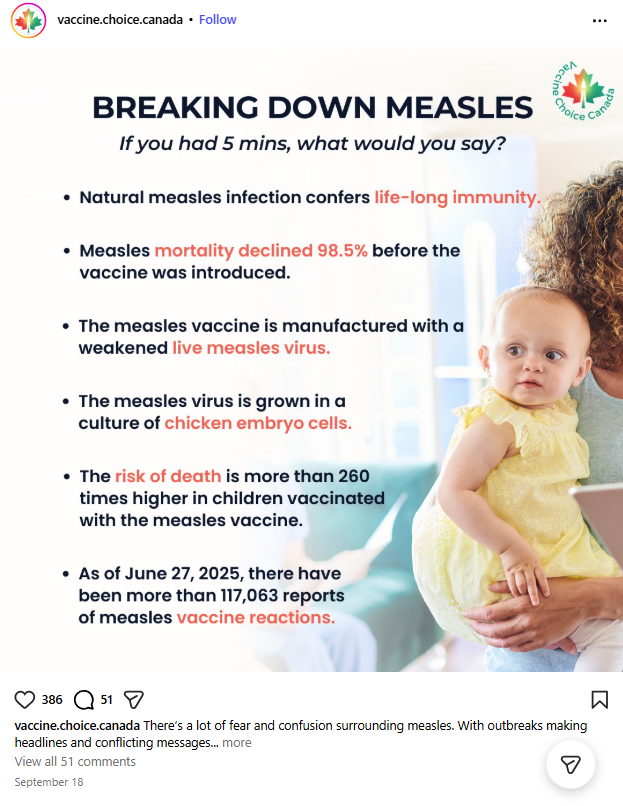
Before we take their word for it, let’s quickly investigate Vaccine Choice Canada to learn more about their agenda and reputation. By searching “vaccine choice canada wikipedia” we find their Wikipedia entry, which identifies them as Canada’s main anti-vaccination advocacy group.
Here we learn they have contributed to vaccine hesitancy in Canada by encouraging Canadians to not receive vaccination and legislators to support anti-vaccine laws. One of the ways they do this is by spreading false and misleading information designed to create fear and confusion around vaccines.
In other words, this is definitely not a reputable source of information about vaccines, health or health policy!
Activities
- Show students the post and ask them to identify the source.
- Have students use Wikipedia to learn more about the source by searching “vaccine choice canada wikipedia” and clicking on the Wikipedia entry. Guiding questions:
- What is its agenda of Vaccine Choice Canada?
- Do you think the main goal of this post is to inform, to sell, to persuade, or to entertain? How do they use the information in the post to achieve that purpose?
- Is Vaccine Choice Canada a reliable place to learn about measles and vaccines? Explain your reasoning.
- Ask students to find high-quality sources to learn more about measles vaccines, such as medical experts, public health authorities, and professional news organizations.
Review and Discuss Key Concepts (optional)
- Watch Skill: Advanced Wikipedia – Bias & Agenda and review the distinction between bias and agenda:
Bias: The favouring of one view over another.
Agenda: What a person or group is trying to do. - Watch CIVIX Explains: Persuasive Sources and review the following term:
Advocacy: An activity by an individual or group that aims to influence public opinion and decisions within political, economic, and social institutions. Advocacy-focused activities can include media campaigns, public speaking and publishing research. - Explain the concept of cherry-picking: selectively choosing data that supports a particular position while ignoring evidence that contradicts it. This is a common tactic in pseudoscience and includes highlighting a single study that supports a claim while ignoring the broader scientific consensus, or using outdated, misinterpreted, or out-of-context data to make an argument seem stronger than it actually is. For example, the claim that “the risk of death is more than 260 times higher in children vaccinated with the measles vaccine” is based on data from a website where people submitted their own information, and not from any scientific study that was designed to determine if a vaccine actually caused the health problem reported. Ask students to explore how other claims in the post are examples of cherry-picking.
Related Resources
- LESSON: Verification Skills Lesson 2: Investigate the Source
- VIDEO: Investigate the Source (1:38 minutes)
- VIDEO: Skill: Just Add Wikipedia (6:42 minutes)
- VIDEO: Skill: Advanced Wikipedia – Bias & Agenda (6:20 minutes)
- VIDEO: CIVIX Explains: Persuasive Sources (3:40 minutes)