


Check the Claim: Is a Harry Potter villain the new mascot for Chinese New Year?
SKILL: Check the Claim
DIFFICULTY: Simple
SUBJECT(S): Pop Culture
Posted: February 6, 2026
Students will check this claim to find that wordplay with the Mandarin version of Draco Malfoy’s name has inspired Lunar New Year memes and decorations.
Related Lesson
Verification Skills Lesson 3: Check the ClaimLink to Example
Chinese New Year’s new mascot (Instagram)
Background
In China, and Chinese communities around the world, Lunar New Year (also known as Chinese New Year or Spring Festival) is an important holiday that celebrates the arrival of spring and the beginning of a new year on the lunisolar calendar. Each lunar year is represented by one of twelve animals from the Chinese Zodiac. The 2026 lunar year, from February 17, 2026 to February 5, 2027, will be the Year of the Horse.
About the Example
Teacher Note: If you cannot access Instagram, click here to view a screenshot of the post that you can share with your students.
This Instagram post shows Harry Potter villain Draco Malfoy on a red banner in what looks to be a shopping mall, with text claiming that he has become a symbol of Chinese New Year in China.
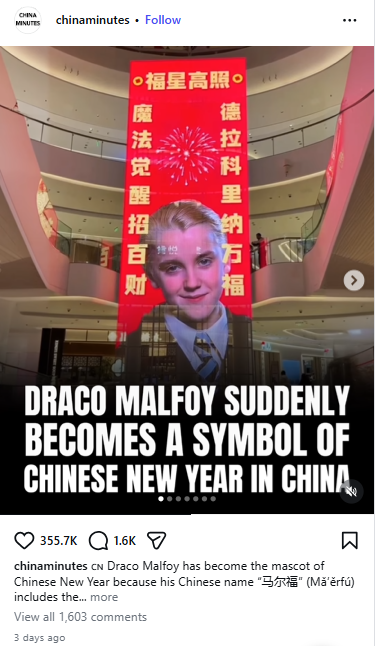
You might be stupefied by this story, but a quick claim check can rennervate us (for those less familiar with the spells, that means stunned and revived). By searching keywords like “draco malfoy chinese new year” we find coverage from The BCC, CNN, The Guardian, and The Independent. These articles confirm that Draco Malfoy has indeed appeared in Lunar New Year memes, decorations, and displays, though he is not an official mascot for the holiday.
We also learn the connection comes from the Mandarin transliteration of Draco Malfoy’s name: “mǎ ěr fú”. The first character, “mǎ” (马) means “horse” while “fú” (福), “fortune” or “prosperity”, is already a symbol of Lunar New Year. This roughly translates to “horse fortune”. Since 2026 is the Year of the Horse according to the Chinese Zodiac, this wordplay inspired some to create, share and sell their own Malfoy decorations.
Activities
- Show students the Instagram post and ask them to summarize the claim.
- Have students check the claim using a keyword search. Guiding questions:
- Is the claim true, false or somewhere in the middle? Explain your reasoning.
- Even when a claim turns out to be true, why is it important to trade up to a higher quality source of information before sharing or repeating it?
- As an optional activity, ask students to use a reverse image search (demonstrated in the video “Skill: Search the History of an Image”) to determine where the image of the shopping mall banner is from.
Related Resources
- LESSON: Verification Skills Lesson 3: Check the Claim
- VIDEO: Check the Claim (2:18 minutes)
- VIDEO: Skill: Check Other Sources (6:18 minutes)